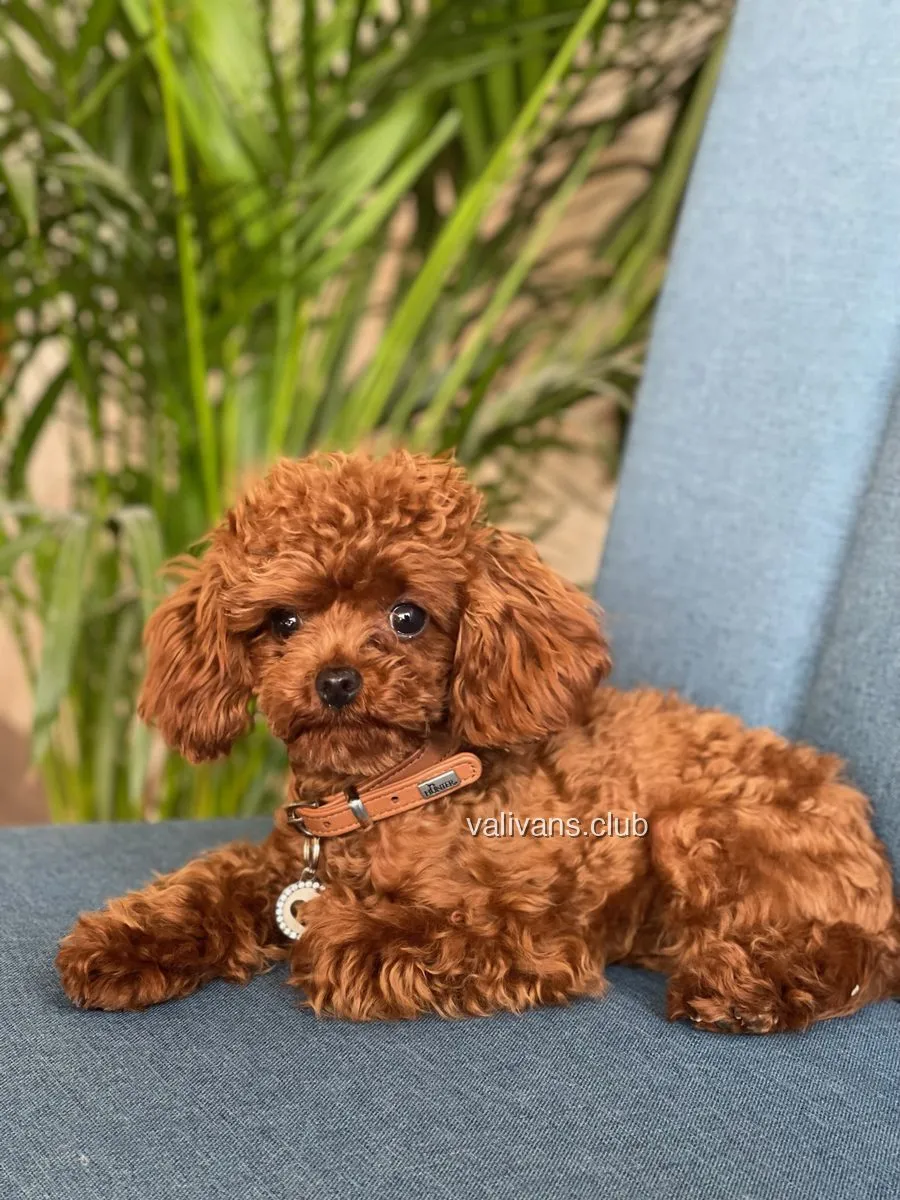
The red Toy Poodle is the most in-demand color in the breed, a deep, glowing coat that ranges from rich mahogany to warm copper. Behind that color sits some of the trickiest genetics in the dog world, which is exactly why a truly red, non-fading Toy Poodle from proven lines is so prized.
As a Ukrainian family kennel breeding Toy Poodles in Valencia, Spain, Valivans specializes in red Toy Poodles. This guide explains what makes a poodle red, the shades you'll see, how to keep the color rich, and how to find a healthy red puppy.
What Makes a Toy Poodle Red?
Red is not a separate "rare breed"; every red Toy Poodle is a standard Toy Poodle (the smallest FCI-recognized variety) that happens to carry red coat genetics. Two things have to line up:
- The recessive red/apricot base (e/e). A red poodle is genetically e/e at the MC1R gene, which switches the coat to red-yellow pigment (phaeomelanin) instead of black or brown. Both parents must pass on the recessive e allele.
- "Rufus" intensity modifiers. Whether that e/e coat reads as pale cream, apricot, or deep red is set by a stack of polygenic modifiers breeders call rufus. Strong modifiers from both parents are what push the color into true red.
Key Fact
Red and apricot are the same base genotype (e/e) at different intensities: apricot is a lighter expression, red is the deep end. That's why pairing strong reds is the reliable way to produce red, and why deep reds are harder to breed consistently.
Shades of Red & Apricot
"Red" covers a spectrum. The shades you'll commonly see:
| Shade | Look | Notes |
|---|---|---|
| Mahogany red | Deep, dark red-brown | The most prized; hardest to hold into adulthood |
| Red | Rich copper-red | The classic "red Toy Poodle" look |
| Dark / red-apricot | Warm orange-gold | Border between deep apricot and light red |
| Apricot | Soft golden tone | Same e/e base, lighter rufus modifiers |
Registries record all of these as solid colors. The nose and points stay dark; a black nose on a red coat is a sign of correct pigment.
Do Red Toy Poodles Fade?
Often, yes, and it's normal. Many reds are born very dark and "clear" (lighten) as they mature over the first one to two years. How much they hold depends almost entirely on genetics: dogs from lines selected for color-holding keep a richer adult coat, while weaker-modifier reds drift toward apricot.
You can't add color that isn't in the genes, but you can protect what's there:
- Limit harsh sun: UV oxidizes the coat and lightens red over time.
- Use color-safe, gentle shampoos: avoid harsh clarifying products that strip warmth.
- Keep the coat healthy: good nutrition and conditioning keep pigment looking deep.
Buying Tip
Ask to see adult photos of the parents, not just the puppy. A newborn's color tells you less than the color its sire and dam actually hold as adults. Proven red parents are the best predictor of a red adult.
Red Toy Poodle Temperament
Color has no effect on personality. A red Toy Poodle is, first and foremost, a Toy Poodle: one of the most intelligent dog breeds in the world (poodles rank #2 for working intelligence, just behind Border Collies). What you can expect:
- Highly trainable: quick to learn commands and routines
- Affectionate and people-oriented: they bond closely and love company
- Alert but not yappy when properly socialized
- Great with families: gentle with children and friendly with other pets
- Apartment- and travel-friendly thanks to their small size
At Valivans, puppies are raised in a family home with three children and other dogs, so they arrive confident and well-socialized.
Grooming & Coat Care
Like all poodles, reds have a single, curly coat that sheds very little but grows continuously, so it needs regular upkeep:
- Brushing: every 2–3 days to prevent matting
- Professional groom: every 4–6 weeks
- Bathing: every 2–3 weeks with a color-safe dog shampoo
- Ears & nails: check ears weekly, trim nails every 2–3 weeks
That low-shedding, low-dander coat also makes red Toy Poodles a strong choice for allergy-sensitive homes. No dog is 100% hypoallergenic, but poodles come about as close as it gets.
Size, Health & Lifespan
A red Toy Poodle follows the standard Toy Poodle size: roughly 24–28 cm (9.5–11 in) at the shoulder and 2.5–4 kg (5–9 lbs). See our full-grown Toy Poodle size & growth guide, or the teacup poodle guide for the smallest end.
Well-bred Toy Poodles from health-tested parents live 12–16 years. Responsible breeders health-test their breeding dogs for the conditions small breeds are prone to; color genetics should never come at the expense of the dogs' health.
Are Red Toy Poodles Rare? Why They Cost More
Red is consistently the most requested Toy Poodle color and one of the harder ones to produce well, because it needs strong red genetics on both sides. That combination of high demand and limited supply is why red sits at the top of the price range, especially deep, color-holding red.
How Much Does a Red Toy Poodle Cost?
Price depends on several factors:
| Factor | Impact on Price |
|---|---|
| Color depth | Deep, color-holding reds command the most |
| Pedigree | Documented pedigree and well-chosen parents = higher price |
| Health testing | Full parent testing adds to breeder costs |
| Size | Sellers charge more for the smallest dogs; “teacup” is not an FCI size |
| Location | Varies by country and region |
In Europe, expect roughly €2,500–€5,000 for a red Toy Poodle from a reputable breeder with FCI pedigree and health documentation; deep, saturated reds sit at the upper end. Prices far below this range are a warning sign about breeding practices. (Pricing is a general market guide. Confirm current prices with the breeder.)
From a reputable breeder, the price should include:
- FCI/UKU pedigree documentation
- Veterinary passport & microchip
- Age-appropriate vaccinations
- Health certificate from a licensed vet
- Post-adoption support
Choosing a Reputable Red Toy Poodle Breeder
The breeder you choose determines your puppy's health, temperament, and the color it holds. What to look for:
Green Flags
- Registered with FCI/UKU or a national kennel club
- Health-tests both parents and shows you the documents
- Shows adult photos of the parents so you can judge color-holding
- Raises puppies in a home, not in cages
- Welcomes questions and asks about your home
Red Flags
- No pedigree or health documentation
- Won't show the parents or their adult coats
- Multiple breeds available at once (puppy-mill indicator)
- Prices that seem too good to be true
Looking for a Red Toy Poodle?
Valivans, a Ukrainian family kennel, breeds red Toy Poodles in Valencia, Spain. UKU-registered (FCI-recognised), from health-tested parents, raised at home. We deliver across Europe and internationally.
Frequently Asked Questions
Red is a deep shade of the recessive e/e (red/apricot) coat genotype, intensified by polygenic "rufus" modifiers. A puppy needs two copies of the recessive red gene plus strong modifiers from both parents to hold a rich red coat into adulthood.
Yes. Red is the most in-demand and one of the harder Toy Poodle colors to produce consistently, because it needs strong red genetics from both parents. Deep, non-fading reds from proven lines are especially uncommon.
Many reds lighten somewhat as they mature, and that's normal. Dogs from lines selected for color-holding keep a richer adult coat. Protecting the coat from excess sun and using color-safe grooming helps preserve depth.
In Europe, red Toy Poodles from reputable, health-testing breeders typically cost €2,500–€5,000, with deeper, more saturated reds at the higher end. Always confirm current pricing with the breeder.
Valivans specializes in red Toy Poodles in Valencia, Spain. All puppies come with FCI/UKU pedigree, health certificate, microchip, and vaccinations, and we deliver across Europe and internationally. Contact us at [email protected] or DM @valivans.club on Instagram.
They share the same e/e base genotype: apricot is a lighter expression and red is the deep end of the same color. Pairing strong reds is the reliable way to produce red puppies.