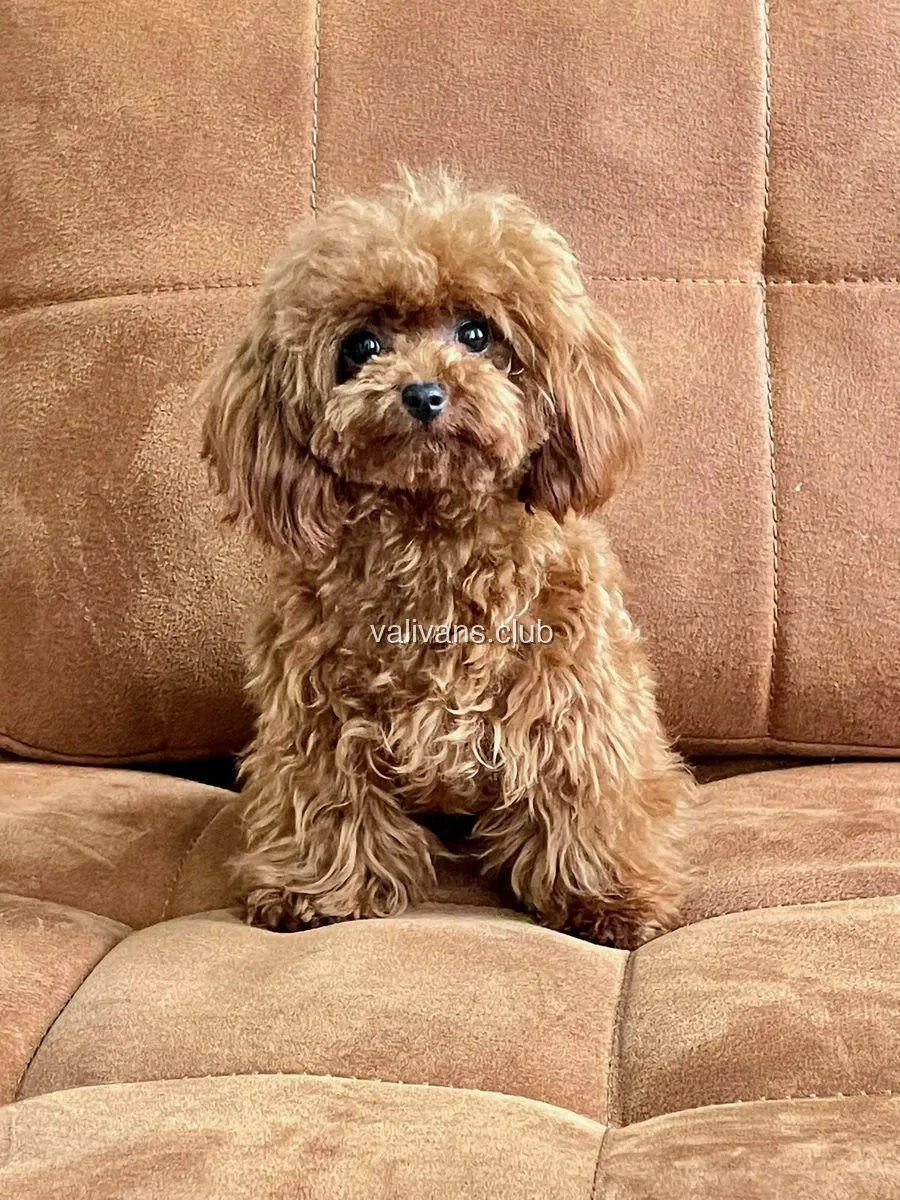
Toy Poodles come in a remarkable range of solid colors — from deep red to jet black to crisp white — plus a few patterns. Color is one of the first things buyers ask about, so this guide walks through every Toy Poodle color, how rare each is, the genetics behind them, and which are recognized in the FCI show ring.
As a Ukrainian family kennel breeding Toy Poodles in Valencia, Spain, Valivans specializes in red, but here we cover the whole palette.
Toy Poodle Colors at a Glance
| Color | Look | Rarity / demand |
|---|---|---|
| Red | Deep mahogany to copper | Rarest solid; highest demand |
| Apricot | Warm golden | Popular; very sought-after |
| Black | Glossy jet black | Common; classic |
| White | Bright pure white | Common |
| Cream | Soft off-white | Common |
| Brown / chocolate | Rich liver brown | Less common |
| Silver | Pale grey (clears from black) | Uncommon |
| Silver-beige / café-au-lait | Muted tan-brown | Uncommon |
| Blue | Very dark slate (faded black) | Uncommon |
| Phantom / parti / sable | Two-tone patterns | Niche; parti is FCI-recognized |
The Genetics in 60 Seconds
A few genes explain most of the palette:
- E locus (MC1R) — the recessive e/e type makes red, apricot and cream (red-yellow pigment). Intensity "rufus" modifiers decide how deep it gets.
- B locus — turns black pigment into brown/chocolate when a dog is b/b (with liver nose and points).
- Progressive greying — a dominant "fading" gene clears black to silver/blue, or brown to silver-beige/café-au-lait, over the first 1–2 years.
Born one color, finishing another
Several poodle colors change with age. Silver and blue puppies are born black; café-au-lait is born brown; reds and apricots often lighten. A reputable breeder can tell you the likely adult color from the lines.
Red & Apricot
Red is the most in-demand Toy Poodle color — a deep, glowing coat from mahogany to copper. Apricot is the same recessive base at a lighter intensity, a warm golden tone. Both often lighten as the dog matures, so adult-color genetics matter. For the full breakdown, see our red Toy Poodle guide.
Black
A true black Toy Poodle has a dense, glossy, blue-black coat with no fading, plus black nose, lips and eye rims. It's one of the most common and most stable colors — what you see in a black adult is largely what the puppy keeps. A solid, even black is prized in the show ring.
Brown & Chocolate
Brown (also called chocolate or liver) ranges from rich dark chocolate to a lighter brown. Brown dogs have liver-colored noses and points rather than black, and amber-toned eyes. Brown can soften toward café-au-lait with age if the dog also carries the fading gene.
White & Cream
White is bright and pure; cream is a soft off-white — genetically a very pale expression of the red/apricot base. White poodles usually keep black noses and dark eyes (important for a clean look) and need a little extra grooming to keep tear-staining down and the coat bright.
Silver, Blue & Café-au-Lait
These are "clearing" colors produced by the progressive-greying gene:
- Silver — born black, clears to a pale grey, usually finishing by about 2 years.
- Blue — a very dark slate; black that has only partially faded.
- Silver-beige / café-au-lait — the brown-coat equivalent, a muted tan.
Because they're born dark and clear slowly, you can't always judge the adult shade from a young puppy — the parents and lines are the best guide.
Patterns: Phantom, Parti, Sable & Abstract
Beyond solids, poodles can be patterned:
- Phantom — a solid base with tan points (like a Dobermann's markings).
- Parti — white plus a second color in patches (at least 50% white).
- Sable — a colored coat with black-tipped hairs.
- Abstract / mismark — mostly solid with small white patches.
These dogs are healthy, affectionate pets. Since 2024 the FCI Poodle standard (No. 172) recognizes an "Other colours" group — specifically parti/two-coloured, fawn-marked, tricolour and brindle — so those patterns are show-eligible alongside the classic solids. Sable and a single isolated mismark are not in that group (an isolated mark is in fact disqualifying), and many breeders focus on solids by preference.
Which Colors Are Rare — and Do They Cost More?
Rarity and price track demand, not quality. As a rough guide:
- Most in-demand / priciest: deep red, then apricot.
- Mid: brown, silver, and the unusual clearing colors.
- Most available: black, white, cream.
A puppy's price reflects color demand plus pedigree, health testing and size — color alone shouldn't be the whole story. (Color price premiums vary by market — confirm with the breeder.)
Does Color Affect Health?
In normal solid-colored Toy Poodles, color has no bearing on health — a black poodle and a red poodle are equally robust. The one real caution is merle: merle isn't a natural poodle pattern, and breeding two merles ("double merle") is linked to deafness and eye defects. If a "merle poodle" is offered, ask hard questions about how it was produced.
Whatever the color, the things that actually protect your puppy are health-tested parents, an FCI/UKU pedigree, and a breeder who raises pups in a home. Color is the fun part; health testing is the important part.
Looking for a Red or Apricot Toy Poodle?
Valivans, a Ukrainian family kennel, breeds red Toy Poodles in Valencia, Spain — UKU-registered (FCI-recognised), from health-tested parents, raised at home. We deliver across Europe and internationally.
Frequently Asked Questions
Among solid colors, true deep red is the rarest and most in-demand, because it needs strong red genetics from both parents. Patterns like parti are also uncommon; since 2024 parti/two-coloured, fawn-marked, tricolour and brindle fall under the FCI standard's "Other colours" group, though many breeders still focus on solids by preference.
Solid colors include red, apricot, cream, white, black, brown/chocolate, silver, silver-beige, blue and café-au-lait. Patterns include phantom, parti, sable and abstract; of these, the FCI "Other colours" group covers parti/two-coloured, fawn-marked, tricolour and brindle, while sable and isolated mismarks aren't show-eligible.
Yes, some do. Reds and apricots often lighten with age, and silver and blue puppies are born black and clear to their adult color over the first couple of years. Black, white and brown are generally more stable.
Color affects price through demand — red and apricot usually cost the most. Color itself doesn't affect health in solid-colored poodles; the main caution is merle, a pattern not native to poodles whose double-merle form carries health risks.
The FCI Poodle standard recognizes solid black, white, brown, grey (silver) and fawn/red shades (apricot and red). Since 2024 (standard No. 172) it also adds an "Other colours" group covering parti/two-coloured, fawn-marked, tricolour and brindle dogs, so those patterns are show-eligible too. Sable and a single isolated mismark are not (an isolated mark is disqualifying); many breeders simply focus on solids by preference.
Valivans specializes in red Toy Poodles, one of the most in-demand colors, from health-tested parents in Valencia, Spain. Contact us at [email protected] or DM @valivans.club on Instagram.