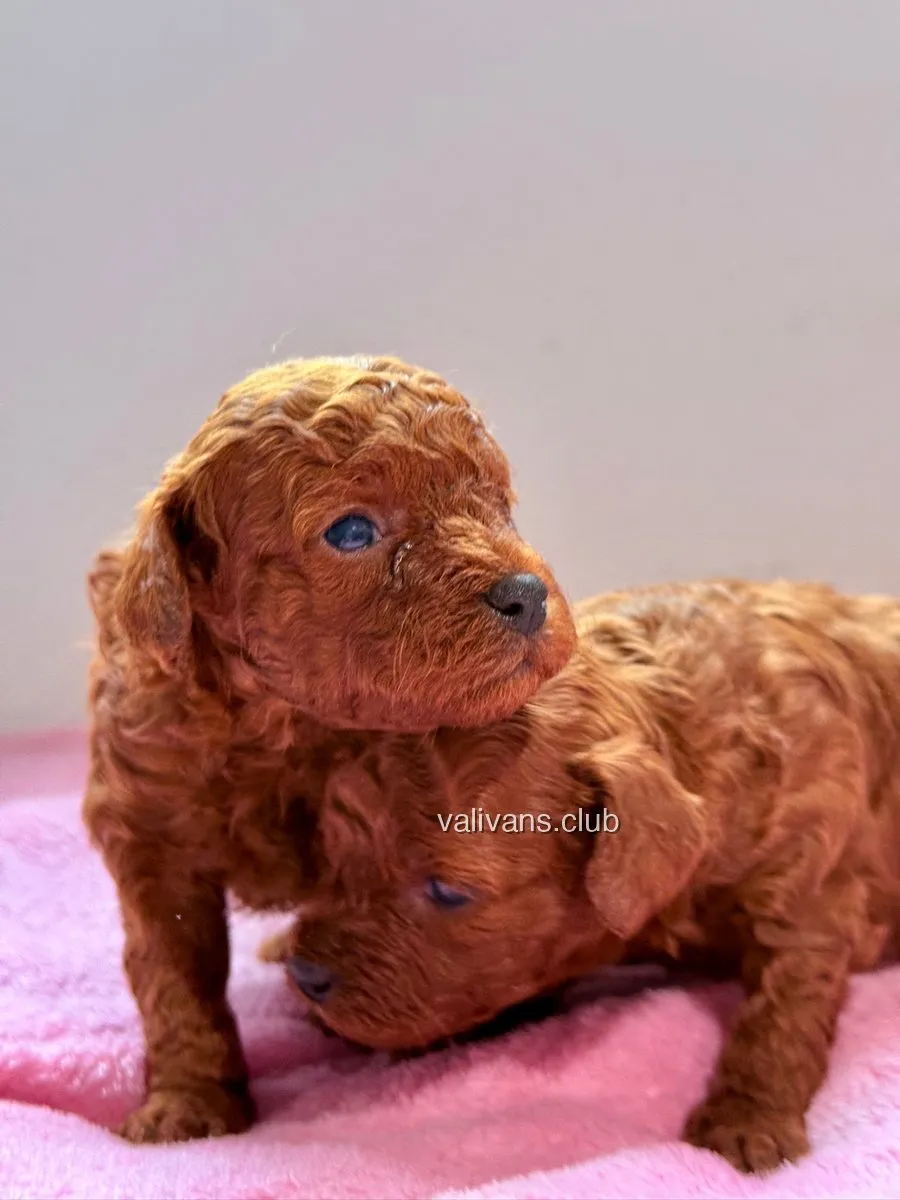
A Toy Poodle usually has two to four puppies in a litter. One puppy is fairly common, five happens, six is rare, and anything above that is a story breeders tell each other for years. If you came here because a breeder told you to wait and you wanted to know why, this number is the whole answer: a tiny dog has tiny litters. Below is how that plays out in practice, what moves the number up or down, and what it means for you as a buyer. For everything else about the breed, start with our Toy Poodle breed guide.
The short answer
Typical Toy Poodle litter: 2 to 4 puppies. Usual range: 1 to 5. Pregnancy: about 63 days. Puppies leave for new homes at 8 weeks at the earliest, and many breeders of toy breeds keep them longer. Every litter is different, so no honest breeder promises a number before the puppies are born.
Litter Size by Poodle Size
Poodles come in four FCI sizes that share one standard, and litter size tracks body size almost exactly. The smaller the mother, the fewer puppies there is room for. The ranges below are what breeders typically see; a given litter can fall outside them.
| Poodle size (FCI) | Height | Typical litter |
|---|---|---|
| Toy | 24 to 28 cm | 2 to 4 puppies, sometimes 1 or 5 |
| Miniature | 28 to 35 cm | 3 to 6 puppies |
| Medium | 35 to 45 cm | 4 to 7 puppies |
| Standard | 45 to 60 cm | 6 to 8 puppies, sometimes more |
This is also why the very smallest females are not the ones a careful breeder wants to breed from. A Toy at the bottom of the size range carries fewer puppies, has a harder time whelping and is more likely to need a caesarean. If you are curious about where the Toy sits among the sizes and why "smaller still" is a marketing idea rather than a breed, read our guide to the real smallest Poodle size.
What Changes the Number
Two Toy Poodle females of the same size can have litters of one and of five. The difference usually comes down to a few things that breeders watch closely.
- The mother's age. First litters tend to be smaller. Litters are usually largest when the female is around three to four years old and get smaller again as she ages.
- Timing of the mating. A dog ovulates once per heat, and the fertile window is short. Breeders who confirm ovulation with progesterone tests at the vet get more consistent results than those who count days from the start of the heat.
- The sire. Semen quality drops with age, heat stress and illness. A fresh natural mating with a healthy male gives the best odds; chilled or frozen semen often means a smaller litter.
- Health and condition. A female in good weight, on a complete diet and up to date with her vet checks carries a litter better than one that is underweight or overweight. Thyroid problems and uterine infections quietly reduce litter size, which is one reason health-tested parents matter.
- Genetics. Some lines simply throw bigger litters. A breeder who has kept records for years knows what to expect from each female.
- Luck. After everything above, there is still a wide spread. Nobody controls how many eggs are released or how many embryos implant.
From Mating to Going Home: the Timeline
Dog pregnancy lasts about 63 days from ovulation. Counted from the mating date, which is what most people know, it can look like anything from 58 to 68 days, because sperm can wait several days inside the female for the eggs. A vet can confirm the pregnancy by ultrasound from around day 25 to 30, and an X-ray in the last week shows the number of skeletons, which is the only reliable way to count puppies before the birth.
Toy Poodle puppies are born weighing roughly 100 to 200 grams, about the weight of a bar of soap. For the first two weeks they do little but drink and sleep. Eyes open at around 10 to 14 days, the first wobbly steps come in week three, and by five to six weeks they are small, noisy, curious dogs who have started on solid food. Breeders use weeks three to eight for the socialisation work that shapes the adult temperament: household sounds, floors of different textures, visitors, car rides, gentle handling of paws and ears.
Eight weeks is the earliest a puppy should leave its mother and littermates. Many breeders of toy breeds hold puppies until 10 or 12 weeks, because a Toy puppy at eight weeks is still tiny and fragile, can have blood-sugar dips if it skips meals, and benefits from a few more weeks with its mother. Our Toy Poodle puppy guide covers what the first weeks at home then look like.
Why Small Litters Mean Waiting Lists
Here is the arithmetic that every buyer of a small purebred eventually runs into. A responsible kennel of any size keeps a limited number of breeding females, because each one lives in the house as a pet, not in a run. Kennel-club rules and plain decency mean a female is bred only on some of her heats, with a long rest in between, and only during a few years of her life. Each litter brings two to four puppies. Add the fact that some buyers want a female, some want a male, some want a particular colour, and the number of puppies that fit a given request in a given year is tiny.
On the other side, the breed is popular. A kennel with any reputation gets far more enquiries than it has puppies, so a waiting list is the fair way to deal with it: people are matched to puppies in order and by fit, not by who sent the fastest message. For you as a buyer this has two consequences. First, a breeder who always has puppies available right now, in any colour you like, is either very large or not telling you everything. Second, the best time to get on a list is before you need the puppy, not the week you decide you want one. If you want to understand the price side of the same equation, see our Toy Poodle price guide.
Does Litter Size Affect the Puppy?
Not in the way most people worry about. A puppy from a litter of two is not weaker or less "real" than one from a litter of five; if anything it had more milk and more attention. What litter size does change is the early social education.
A singleton puppy, which is common in toy breeds, grows up without littermates to play with. Puppies learn bite control, frustration tolerance and how to read other dogs from those early squabbles over the milk bar. A good breeder compensates: more handling, meetings with calm adult dogs, time with another litter if one exists in the house, and honest advice to the new owner about puppy classes. It is manageable, but it is work, and it is a fair question to ask.
At the other end, a litter of five or six on a small Toy mother means the breeder weighs every puppy daily, may bottle-feed the smallest, and watches the mother's calcium levels. Those puppies arrive just as healthy; they simply took more work to raise.
Questions Worth Asking a Breeder
- How many puppies were in this litter, and what sex and colour are they? A straight answer is normal; vagueness is not.
- How are puppies allocated? Order on the list, fit with the family, or the breeder's own choice of which puppy stays for breeding. All three are legitimate; you just want to know the rules.
- Are the parents health-tested, and can I see the results? Healthy parents carry litters better and pass fewer problems on.
- How old is the mother, and how many litters has she had? A female bred on every heat, or still bred past the age where kennel-club rules allow it, is a red flag whatever the litter size.
- At what age do puppies leave? Eight weeks is the floor. A breeder offering a six-week-old puppy is cutting a corner that matters.
None of these questions has a "right" number. What you are listening for is a breeder who knows their dogs, keeps records, and does not promise what biology does not allow.
Looking for a Toy Poodle puppy?
Valivans, a Ukrainian family kennel in Valencia, Spain, breeds red and apricot Toy Poodles: health-tested parents, puppies raised at home, UKU pedigrees (FCI-recognised). Join the waitlist, or write to us by email or on Instagram.
Frequently Asked Questions
Most Toy Poodle litters have two to four puppies. A single puppy is not unusual, and five happens now and then, while six is rare. Every litter is different, so a breeder cannot promise a number in advance.
Litter size follows body size. A Toy Poodle female weighs only a few kilograms, so there is room for a handful of puppies, not a crowd. Miniature Poodles usually have a few more and Standard Poodles often have six to eight or more.
About 63 days, counted from ovulation. Counted from the mating date it can look like anywhere from 58 to 68 days, because the egg and the sperm do not always meet on the day of mating.
Not in itself. A singleton puppy grows well, but it misses the play and the small squabbles with littermates that teach bite control and patience. Good breeders make up for that with extra handling and, where possible, time with other puppies or calm adult dogs, and new owners continue the work at puppy classes.
Because the maths is simple: a small kennel keeps a few breeding females, each female is bred rarely, and each litter brings two to four puppies. That is a handful of puppies per year against many enquiries, and some buyers also want a particular colour or sex. A waiting list is how a responsible breeder matches those few puppies to the right homes instead of to whoever messages first.