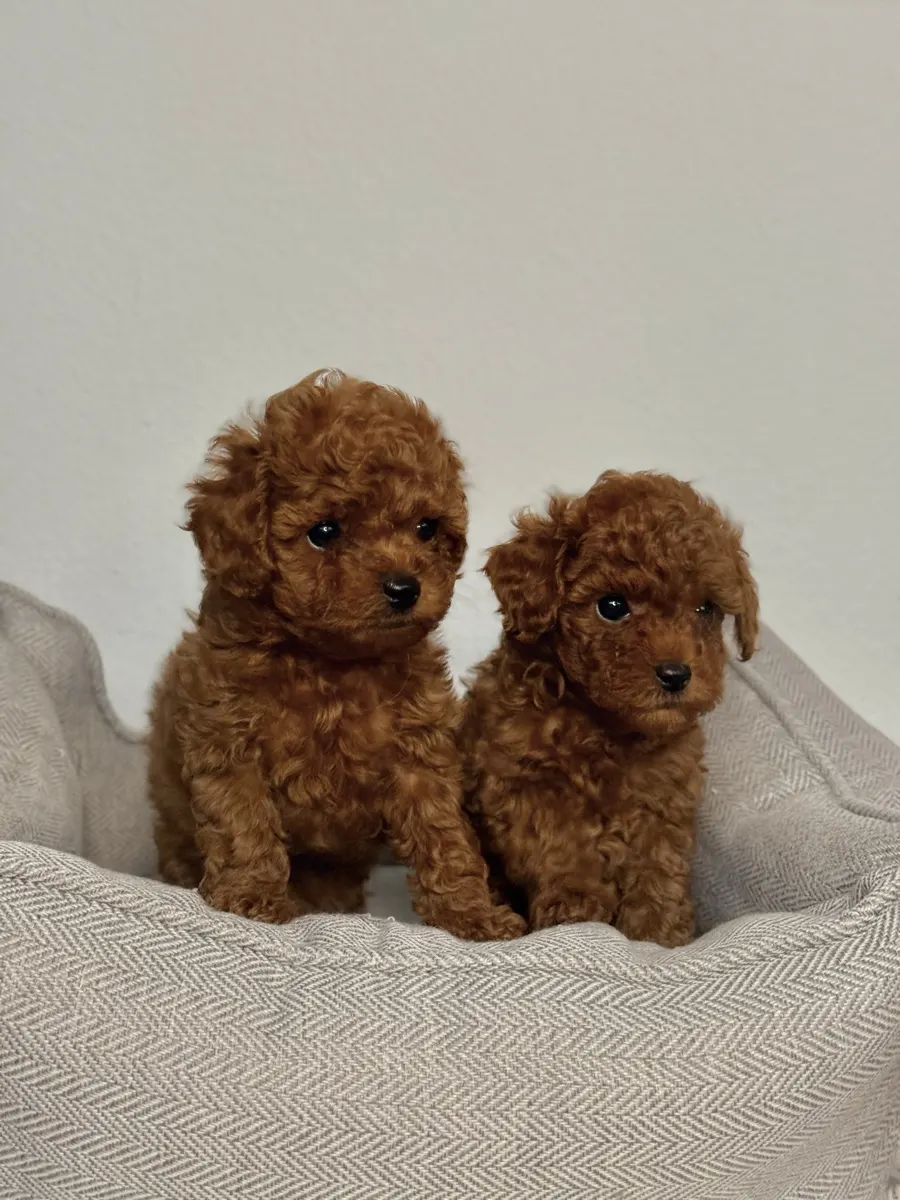
The smallest poodle is the Toy Poodle. By the FCI standard it stands 24–28 cm (9.5–11 in) at the withers and, by breeder estimate, weighs about 2.5–4 kg (5–9 lbs). That is the whole answer to "what is the smallest poodle breed" — but it is rarely the whole question. What people usually want next is how far down that range a healthy dog can go, what the smaller-than-Toy labels actually mean, and whether the tiniest poodle is the right one for their home. This guide answers those in order.
Valivans is a Ukrainian family kennel now in Valencia, Spain. We breed red and apricot Toy Poodles within the FCI standard.
The Poodle Size Ladder
The poodle is one breed in four sizes. The FCI (standard No. 172) separates them by height at the withers only; weight is not part of the standard, so every kilogram figure below is a practical breeder estimate, not an official rule.
| Variety | Height (FCI) | Weight (estimate) |
|---|---|---|
| Toy — the smallest | 24–28 cm (9.5–11 in) | ~2.5–4 kg (5–9 lbs) |
| Miniature | 28–35 cm (11–14 in) | ~5–7 kg (11–15 lbs) |
| Medium | 35–45 cm (14–18 in) | ~8–15 kg (18–33 lbs) |
| Standard | 45–60 cm (18–24 in) | ~20–32 kg (45–70 lbs) |
Every rung shares the same breed standard apart from height: the same curly, low-shedding coat, the same intelligence and the same affectionate temperament. A Toy is a Standard scaled down, not a different dog. The step that matters most to buyers is the first one — for a side-by-side of the two smallest sizes, see Toy Poodle vs Miniature Poodle.
Key Fact
There is no FCI variety smaller than the Toy. "Teacup", "micro" and "tiny" are marketing labels for Toy Poodles at the bottom of the range, not varieties, and a dog with papers is registered as a Toy Poodle. Our teacup poodle guide covers that unofficial end in detail.
How Small Does a Toy Poodle Actually Get?
The standard gives the Toy a 24 cm minimum, so the smallest a Toy Poodle should be as an adult is about 24 cm (9.5 in) at the shoulder and roughly 2.5 kg (5 lbs). The upper end, 28 cm and around 4 kg, is still a very small dog — light enough to carry on one arm and to fit a cabin-sized carrier.
Within that band, individual dogs vary with their parents. Naturally petite Toys can land a little under 24 cm, and that is where the "teacup" label gets applied. Below the standard, though, you are no longer looking at a more desirable poodle — you are looking at a dog outside what the breed is meant to be.
Two practical notes on size:
- Adult size arrives early. Toy Poodle puppies reach most of their adult height by 7–10 months and are generally full-grown by 12 months. Our full-grown Toy Poodle guide has the month-by-month growth chart and how to estimate a puppy's adult size.
- Parents predict better than a puppy's weight. The parents' height and the size of previous litters tell you far more about where a puppy will finish than how small it is at eight weeks.
The Smallest Healthy Size
The smallest healthy poodle is a Toy at the lower end of its standard, bred from health-tested parents — not the smallest number a seller can promise. The tiniest dogs can be a little more prone to fragility-related issues such as dental crowding and patellar luxation, and any breeder pushing for unnaturally small dogs is trading the dog's robustness for a selling point.
A responsible breeder produces small Toys through careful selection of petite, healthy parents, never by breeding runts or underfeeding puppies. Be wary of "micro" or extreme-tiny promises far below the range in the table above. When you are comparing litters, the questions that protect you are the same at every size:
- Health testing on both parents — patellar luxation, prcd-PRA and other eye disease are the screenable conditions in the small varieties.
- An FCI-recognised pedigree (UKU or another FCI-member club) that names both parents and confirms the dog is registered as a Toy.
- A home-raised litter you can see, rather than a photo of a single puppy with a weight in the caption.
Whichever end of the Toy range you choose, a lean adult weight and good dental care matter more for lifespan than the last centimetre of height.
Is the Smallest Poodle Right for Your Home?
The Toy Poodle's size is the reason it fits places larger dogs cannot, and also the reason it is not the right fit for every household.
Apartments and small flats
A Toy is one of the best apartment dogs there is: clean, low-shedding, quiet when well socialised and small enough that a one-bedroom flat is plenty. It is content with about 30 minutes of walks and play a day plus some training games — mental exercise counts as much as physical for a poodle. See are Toy Poodles good apartment & family dogs for the full picture.
Travel
At 2.5–4 kg a Toy Poodle is easy to travel with — light to carry, small enough for a cabin-sized carrier and happy in a hotel room. Check each airline's own cabin-pet weight and carrier limits before booking; they differ, and the limit usually includes the carrier.
Children and other dogs
This is the one place where smallest is not best. A 3 kg dog is delicate around boisterous toddlers and large, rough-playing dogs. Toys are wonderful with gentle, older children; for a home with very young, active kids a sturdier Miniature Poodle is often the safer choice.
Quick Fit Check
Choose the Toy if you want the smallest possible companion, live in a compact space, travel often, or want a true lap dog and your household is calm. Step up to the Miniature if you have young children, large dogs or want more stamina for long walks.
Toy Poodles From Valivans
Valivans breeds red and apricot Toy Poodles: a Ukrainian family kennel, UKU-registered (FCI-recognised), now in Valencia, Spain. Puppies are raised in a family home with three children and other dogs, so they arrive confident and well socialised. If you are looking for a breeder in Spain, read about our Ukrainian Toy Poodle kennel in Valencia, or join the waitlist below.
Looking for a Toy Poodle?
Valivans breeds red and apricot Toy Poodles in Valencia, Spain. Ukrainian UKU-registered (FCI-recognised). We deliver across Europe and internationally.
Frequently Asked Questions
The Toy Poodle. The FCI recognises four poodle sizes — Standard, Medium, Miniature and Toy — separated by height at the withers, and the Toy is the smallest at 24–28 cm (9.5–11 in). In practice a Toy weighs about 2.5–4 kg (5–9 lbs), a breeder estimate rather than a figure from the standard. Anything sold as smaller than a Toy is still a Toy Poodle by registration; "teacup" is a size label, not a variety.
The FCI standard sets a 24 cm minimum for the Toy Poodle, so the smallest a Toy should be as an adult is about 24 cm (9.5 in) and roughly 2.5 kg (5 lbs). Naturally petite Toys from small, health-tested parents can land a little under that, but a dog well below the standard is outside what the breed is meant to be — smaller is not automatically better.
No. The Toy is the smallest poodle variety recognised by the FCI. "Teacup", "micro" and "tiny" are marketing labels for very small Toys, not separate varieties, and a registered dog is a Toy Poodle on its papers.
A Toy Poodle at the lower end of its standard — about 24 cm and around 2.5 kg — from health-tested parents. The very tiniest dogs can be a little more prone to fragility-related issues such as dental crowding and patellar luxation, so a responsible breeder produces small dogs through careful selection of petite, healthy parents, not by breeding runts or underfeeding puppies. A healthy small Toy is the goal, not the smallest number.
Yes — the Toy Poodle is one of the best apartment dogs there is: clean, low-shedding, quiet when well socialised and light enough to carry. At 2.5–4 kg it needs little floor space and is content with about 30 minutes of walks and play a day plus training games. It suits calm homes and older, gentle children best; for boisterous toddlers a sturdier Miniature is the safer pick.