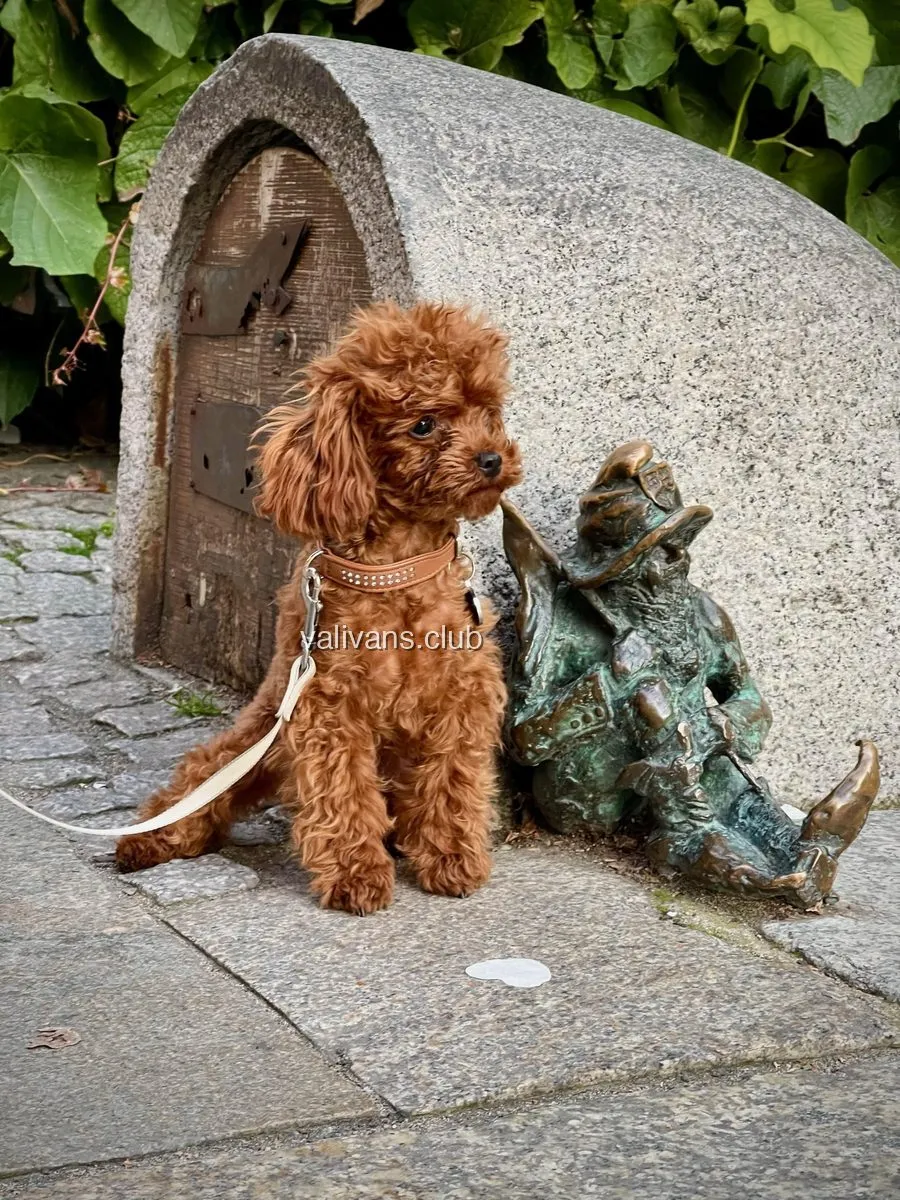
The first weeks with a Toy Poodle puppy almost always revolve around one question: how do I house-train it, on a pad for now and outdoors later? A Poodle works out quickly what you want, but a small puppy has a tiny bladder and physically cannot hold it for long. This guide covers how to choose between pads, a litter tray and outdoors, the potty routine a young puppy needs, how to move the pad and switch to walks, what to do about accidents, and when a vet should take a look. This page goes with our Toy Poodle puppy guide and the training guide.
Looking for a Toy Poodle?
Write to us at [email protected] or message us on Instagram @valivans.club.
Why a puppy cannot hold it
At two or three months a puppy's bladder is small and the muscles that control it are still maturing. The puppy is not being naughty and is not taking revenge because you went to the kitchen: it simply did not make it in time. The smaller the dog, the more often it needs to go, and a Toy Poodle sits in the smallest category. Hence the main rule of the first weeks: do not wait for the puppy to ask, take it to the pad or outside ahead of time, on a schedule. Bladder control comes with age. Until then, your job is to stop the habit of going anywhere from setting in.
Pad, litter tray or outdoors: how to choose
There is no single right answer. It depends on your home, your working hours and whether the puppy has finished its vaccinations. Many Toy Poodle owners start with a pad indoors and move outdoors gradually; some keep an indoor potty spot for good as a backup for illness, bad weather or a long working day.
| Option | Who it suits | Watch out for |
|---|---|---|
| Pee pad | Puppies that have not finished vaccinations; upper floors without an elevator; owners with long working days. | A puppy may treat any rug or towel as a pad; the pad needs changing often or the puppy starts missing next to it. |
| Litter tray (with a pad or substrate) | Anyone who wants a permanent indoor potty spot; small dogs and cold or rainy months. | It needs low sides so the puppy can get in by itself; males may start lifting a leg later; some owners use a tray with a post for that. |
| Outdoors | Puppies with vaccinations complete; households where someone can go out often. | The first weeks mean very frequent trips, including very early and very late; in rain and heat the puppy needs you to go with it. |
Whichever you choose, do not change it every other day. A puppy learns by repetition, and what it needs most is the same place and the same reaction from you.
The routine: when to take the puppy out
The schedule matters more than any command. A young puppy needs the pad or a trip outside:
- Straight after waking, including a short nap. A puppy wakes and pees almost at once, so carry it to the spot before it has wandered around the apartment.
- After eating and drinking, usually within minutes. Feed at set times, several small meals a day as your vet advises for toy puppies, rather than leaving the bowl full all day. That makes bathroom trips predictable.
- After play and any excitement: visitors, the joy of your return, a bout of rough play.
- Every hour or two in between while the puppy is very young. The gaps grow with age.
- First thing in the morning and last thing at night, ideally in the same way each day, by the same person.
At night a small puppy usually needs at least one trip: a young toy puppy's bladder may simply not last until morning. If needed, set an alarm for a night trip until the puppy sleeps through on its own. Ask your vet how long the gaps between meals and trips can be for your puppy.
Where to put the pad and how to move it
In the first days the pad lies near the sleeping area but not under the bed: puppies rarely go where they sleep, but they do not go far either yet. If the puppy has already picked a corner for itself, start there. In the first days, while the puppy settles in, you can lay two or three pads in different rooms and gradually remove the spares, keeping the one it uses most.
Once the puppy hits the pad reliably, you can move it toward its final spot: a few steps at a time, every few days, toward the door or the balcony if outdoors is the final goal. A pad on a balcony is only an option if the railings and gaps are secured, and never leave the puppy out there alone. If misses start after a move, put the pad back one step and wait longer. Change the pad as soon as it is soaked and lay the new one in the same place. A pad that is sterile-clean can sometimes confuse a puppy, so leave a small damp corner of the old one on the new one: the scent tells the puppy this spot is allowed. A pad that is too dirty, on the other hand, puts the puppy off and leads to puddles next to it.
Reward within seconds
A Poodle is very sensitive to your reaction, and that is your main tool. The moment the puppy finishes in the right place, that same second, give calm praise and a tiny treat that was already in your pocket. A minute later is too late: the puppy will connect the reward with whatever it is doing at that moment, and the pad will have nothing to do with it. If you say "go potty" while the puppy is going, within a few weeks it becomes a cue, and that is a real help outdoors in the rain.
Stay close until the puppy has finished. Many puppies step onto the pad, get distracted, wander off to play, and pee on the floor a minute later. Wait patiently, then praise.
How to tell the puppy is about to go
Almost every puppy gives signals a few seconds before an accident. The sooner you learn to read them, the fewer misses you will have:
- circling on the spot and sniffing the floor;
- suddenly breaking off play and heading for another corner or behind the sofa;
- getting restless, whining, going to the door or to the place where the pad used to be;
- squatting: by now you are late, but you can still quietly pick the puppy up, carry it to the pad and, if it finishes there, praise it.
While the puppy is small, keep it in sight or in a limited area. A puppy roaming the whole apartment will most likely find a spot where you cannot see it.
Accidents: what to do and what not to do
There will be accidents, and they are a normal part of the process. The main rule is simple: no punishment. No scolding, no rubbing its nose in it, no rolled-up newspaper. The puppy will not connect the punishment with a puddle it made earlier, but it will learn very well that peeing in front of you is dangerous, and start hiding in the closet. After that, house-training takes far longer.
If you catch the puppy in the act, calmly carry it to the pad and praise it for finishing there. If you find the puddle later, just clean it up. Use an enzyme cleaner that breaks down the smell. Avoid ammonia-based cleaners: to a dog's nose they smell like urine and leave a clear "bathroom here" marker. Keep bleach away from a puppy and never mix it with urine. Old rugs with a history of puddles are best put away for a while.
Setting up a small apartment
In a small apartment house-training can be easier than in a big house: the puppy is almost always in sight. This set-up helps:
- A playpen or a limited area for the first weeks: bed, water, a couple of toys and the pad in the far corner of the pen, not touching the bed. The puppy stays there when you cannot watch it and earns the rest of the apartment gradually, one room at a time.
- The pad on a washable floor, not on carpet. Put a waterproof mat or a tray underneath: puppies love dragging the pad around, and then they miss at the edge.
- The same route to the potty spot every time. If the pad is in the bathroom, the door stays open; if the potty spot is on the balcony, keep the balcony door open only while you are with the puppy, and only if the railings and gaps are secured.
While the puppy is small, being alone is itself a trigger for puddles. How many hours a puppy can stay alone and how to build up to it is covered in our guide to leaving a Toy Poodle alone.
Outdoors before vaccinations are complete
Full freedom outdoors usually comes only once the puppy's vaccination course is finished; before that, contact with the ground, puddles and unknown dogs carries a risk. Talk to your vet about the timing and about what exactly your puppy may do in the meantime: approaches differ, and many vets allow carrying the puppy out or letting it onto a clean, controlled patch earlier. The general schedule in Spain is in our guide to puppy vaccines in Spain. The pad or tray stays the main potty spot while walks are on hold, and you can still move the puppy outdoors later.
Moving from the pad to outdoors
Once the vet clears walks, do not remove the pad on day one. Take the puppy out at the same moments you used to take it to the pad: after sleep, after meals, after play. Pick one fixed spot near home and go there every time. In the first days, bring a small piece of a used pad (or a fresh pad with a damp corner of the used one on top) and put it on the chosen spot: the familiar scent tells the puppy this is allowed. Take it away with you afterwards. Praise outdoors exactly as you do at home, within seconds. Phase out the indoor pad gradually, once the puppy has done everything on walks for several days in a row; many owners keep it for nights and bad weather.
Male marking versus puppy accidents
If a maturing male lifts a leg on the corner of the sofa or a table leg and leaves a few drops, that may be marking rather than a training miss; if it is new or sudden, rule out a urinary problem with the vet first. It usually begins around sexual maturity and most often in new places or where other dogs have recently been. The same rules apply: thorough cleaning, limiting access and rewarding going in the right place. If marking becomes constant, discuss it with your vet and a trainer; neutering helps some males but does not always undo a habit that has already set in. Females do it less often, but it happens.
How long it takes
Timelines vary a lot. Some puppies almost stop missing within a few weeks, others need months, and small breeds, Toy Poodles included, often take longer than big dogs: the bladder is smaller and the gaps shorter. Count the puppy as house-trained when it has gone several weeks without accidents and heads to the spot by itself; three hits in a row do not mean much yet. A week of backsliding after a move, visitors or a change of pad is normal: just go one step back in the routine. If the backsliding comes with signs of illness, see the vet.
When to call the vet
Sometimes puddles have a medical cause. See a vet or an emergency clinic the same day if the puppy:
- strains with little or nothing coming out;
- cries or whines while going;
- has blood in its urine;
- is listless or refuses food: toy puppies can go downhill fast.
Book a visit in the next few days if the puppy:
- starts peeing much more often than before, in small amounts;
- drinks and pees a lot;
- has urine that is unusually dark, cloudy or strong-smelling;
- was doing well and suddenly starts peeing everywhere with no obvious reason.
Urinary infections, parasites and other health problems do occur in puppies and can be treated, but a vet should check the cause. We are breeders and leave the medical questions to the professionals: if something about your puppy's behavior worries you, one extra consultation beats a month of house-training that goes nowhere.
Planning for a Toy Poodle puppy?
Valivans, a Ukrainian family kennel, breeds red Toy Poodles in Valencia, Spain: UKU pedigrees (FCI-recognized), health-tested parents, puppies raised at home among everyday household life. Write to us by email or on Instagram.
Frequently Asked Questions
From the first day home. At two or three months a puppy can already understand where its potty spot is, as long as the place is fixed, the trips are regular and the praise comes at once. It cannot hold it for long yet, so at the start the result depends mostly on your schedule.
It depends on your home and your hours. Until vaccinations are complete, most people use a pad or a tray; after that many move outdoors, and some keep an indoor potty spot as a backup. The key is not to switch every few days: a puppy learns by repetition.
Most often the pad is too dirty or too small, or it lies on a carpet that feels the same to the puppy. Use a bigger pad on a washable floor and change a soaked pad right away, leaving a small damp corner of the old one on the new one. For the first weeks, keep the puppy in a playpen area.
No. A puppy does not connect punishment with a puddle made earlier, but it does learn that peeing in front of you is dangerous and starts to hide. Clean up with an enzyme cleaner and take the puppy out earlier next time. If you catch it in the act, calmly carry it to the pad and praise it there.
It varies: from a few weeks to several months, and small breeds often take longer than large ones. Count the puppy as trained when it has gone several weeks without accidents and heads to the spot by itself. A sudden regression with no obvious cause, or frequent tiny puddles from an already trained puppy, is a reason to see the vet.