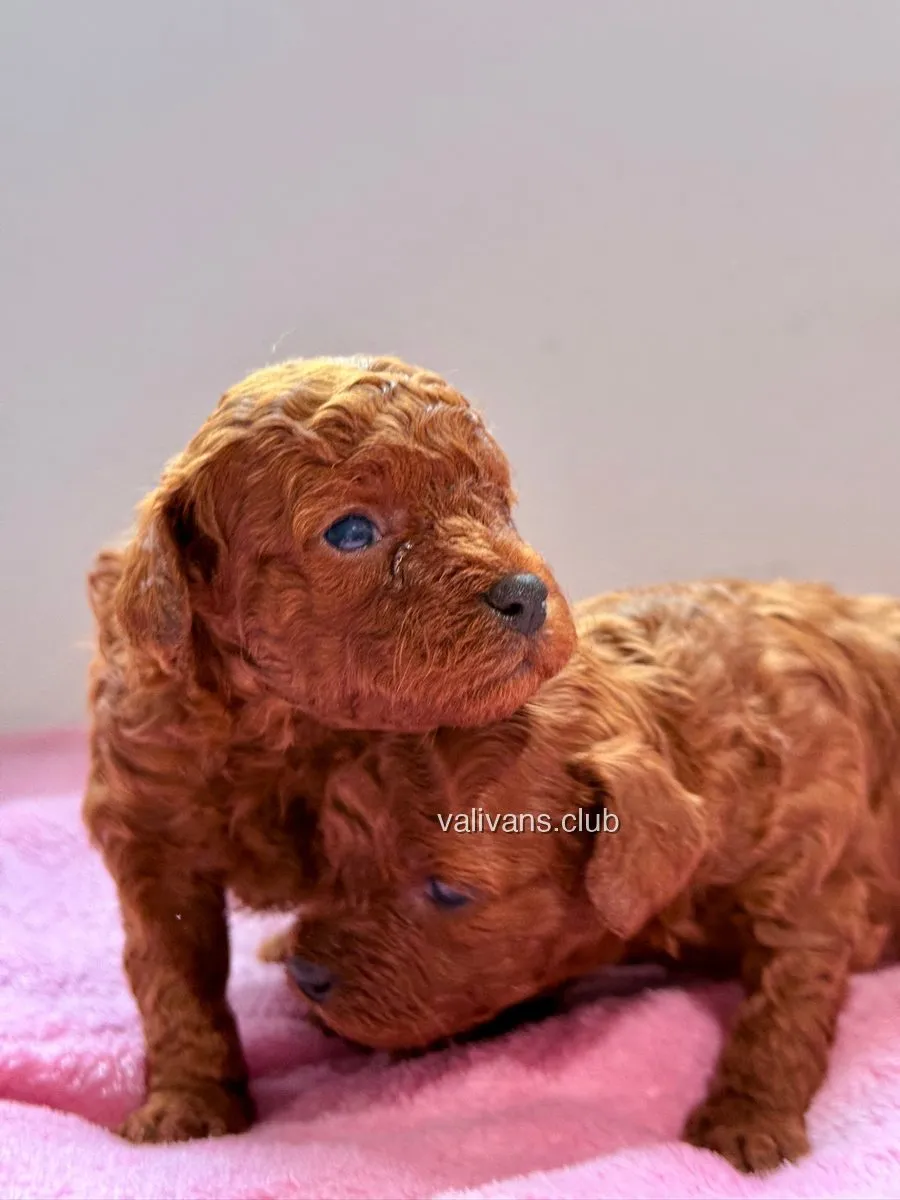
At some point in the first months at home, a Toy Poodle puppy suddenly starts chewing everything in reach, drools more, and leaves tiny spots of blood on its toys. That is usually what teething looks like. Here is how the changeover goes and when a vet needs to see the puppy. This page goes with our Toy Poodle puppy guide and the training guide.
Looking for a Toy Poodle?
Write to us at [email protected] or message us on Instagram @valivans.club.
How a puppy changes its teeth
A puppy arrives in its new home with a full set of baby teeth: small, needle-sharp, and temporary. Baby teeth fall out roughly from about 3 to 7 months, and the timing varies by dog. Adult teeth grow in their place. One puppy has its first loose tooth early, another takes longer, and on its own that is no cause for alarm. Most often the front incisors go first and the canines are among the last to change, though the order can differ.
Owners rarely find the teeth that fall out. The puppy swallows them while eating or playing, and that is usually not dangerous; now and then one turns up in the bed or inside a toy. An adult dog has more teeth than a puppy, so during this same period new molars come in at the back that replace nothing at all, and the gums deep in the mouth can swell and itch as well.
Why a Toy Poodle needs a mouth check during this stage
In small breeds, baby teeth often hang on too long: the adult tooth has already come through and the baby tooth next to it has not fallen out. Toy Poodles are no exception, and it happens most often with the canines. Two teeth in one spot get in each other's way. The adult tooth can come in crooked, food and plaque pack in between them, and over time the gums and the bite suffer. So it is worth having a vet look at the puppy's mouth during the changeover even when nothing seems wrong. A scheduled vaccine or weigh-in is a convenient moment. If a baby tooth is still in place when the adult tooth is clearly visible, the vet decides whether to wait a little longer or remove it. Do not wiggle or pull the tooth yourself. A baby canine has a long root, and it is easy to hurt the puppy or leave a fragment in the gum.
Signs that the teeth are changing
- The puppy chews everything, including things it ignored before: chair legs, the edge of the rug, your fingers.
- More drool, sometimes wet fur around the mouth.
- Small spots of blood on toys or a rag. A few drops when a tooth comes out are normal; bleeding that does not stop within a few minutes needs a same-day vet visit (see below).
- A loose tooth, or a gap where a tooth was yesterday.
- Red, puffy gums and slightly bad breath on the days a tooth is coming through.
- A change in appetite. The puppy takes longer over dry food, chews on one side at first, guards its mouth. It should not stop eating altogether; a puppy that refuses food or water, or is lethargic, should see the vet the same day (see below).
- Grumpiness. The puppy is more restless, asks to be picked up more often or, the other way around, races around and bites harder than usual.
In mild form, all of this is a normal part of growing up. What should worry you is intensity and duration: bleeding that does not stop, or a puppy that refuses food or water or is lethargic. Those mean a vet the same day; a tooth that is clearly out of place means a booked visit within a few days.
What to give the puppy to chew
A puppy relieves itchy gums the only way it knows, by chewing. If you do not give it something suitable, it finds something unsuitable. What helps:
- Rubber toys sized for a Toy Poodle. A toy made for a large dog is too hard and heavy for a puppy's mouth, and a tiny one is dangerous because the puppy can swallow it whole. The rule of thumb is simple: the toy should not fit entirely inside the mouth.
- Toys with some give. A common rule of thumb: if you cannot press a fingernail into the surface at all, the object is too hard for teeth.
- Chilled toys. Keep a rubber toy or a damp, twisted washcloth in the refrigerator for a while. The cold soothes the itch. There is no need to freeze it rock solid: a rock-hard frozen object can be as hard on teeth as a bone.
- Textured toys that massage the gums as a bonus, and edible chews made for small-breed puppies, if your vet is fine with them.
Rotate toys every few days so they stay interesting, and let the puppy chew only under supervision. Even a good toy tears eventually, and the puppy can easily try to swallow the loose piece.
What not to give
- Hard bones, antlers, hooves, and very hard nylon bones. Both baby teeth and freshly erupted adult teeth break on them, and a broken tooth often has to be removed.
- Sticks. They leave splinters in the gums and the roof of the mouth, and the pieces end up in the stomach.
- Anything with small parts: squeakers, plastic eyes on plush toys, children's toys the puppy can tear apart.
- Old shoes and clothes. A puppy cannot tell an old slipper from a new one and carries the habit over to every shoe in the house.
- Rope toys without supervision: swallowed threads are dangerous for the gut.
The puppy bites your hands
A Toy Poodle puppy bites hands most often for two reasons: that is how it played with its littermates, and that is how it scratches itching gums. It is usually not aggression, and in the first months at home almost every puppy does it. The adults' job is to teach the puppy one simple rule: teeth on skin end the game.
- The moment teeth touch your hand, calmly freeze and take the hand away. No shouting, no sudden moves, because a hand that jerks around only becomes more interesting to the puppy.
- Offer a toy right away. If the puppy switches to it, praise it and carry on playing with the toy.
- If the puppy goes for your hands again, leave the game in silence for about a minute: stand up, turn away, or step out of the room. Then come back and start over.
- The same rules for everyone in the family. If one person lets the puppy chew on their fingers in play, everyone else has a much harder time.
- Teach children not to tease the puppy with their hands near its face, not to play with their fingers, and not to run off squealing. Children play with a small puppy only with an adult present.
There is no need to punish biting: no smacks, no pushing the nose into anything, no holding the mouth shut. A puppy that gets hit learns to fear hands rather than to be careful with them, and everything is harder with such a puppy, at the vet and at the groomer too. If the biting gets worse and worse toward evening, the puppy is most likely overtired. A young puppy needs a lot of sleep, and often the only thing that works against the "crazy" biting at 10 p.m. is bedtime in the pen.
Chewing furniture, cables, and shoes
During teething, a puppy chews furniture for the same reasons it chews hands: itchy gums, boredom, and too much energy. What works is a combination of three things.
- Remove the temptations. Cables into covers or behind furniture, shoes into a closed closet, remotes, glasses, and children's toys above puppy height. For the first months, that is easier than fighting over the same slipper every day.
- Limit the space. When you cannot watch the puppy, it stays in a pen or in one prepared room with its bed, water, and a couple of toys. It earns the run of the apartment gradually. This is the same pen we recommended in the guide on house-training a Toy Poodle, and it solves both problems at once.
- Swap the object, no scolding. Catch the puppy chewing a chair leg? Calmly distract it, hand it a toy, and praise it for the toy. After a few dozen repetitions, the puppy starts bringing the toy on its own instead of gnawing the table.
Bitter sprays for furniture work on some puppies, and others never notice them; worth a try, but do not rely on them as the only measure. If the puppy gnaws walls or baseboards, or eats non-food items in quantity, raise it with the vet: sometimes the cause is a health or diet problem.
Dental care from the first months
In small breeds, Toy Poodles included, plaque and tartar build up often, so the brushing habit is best started now, while the puppy is small and learning everything. Go in steps.
- Touch. Several times a day, lift the puppy's lip for a second, touch its muzzle, run a finger along the gums, and praise right away. No paste, no brush, just getting used to it.
- A finger with paste. Once the puppy accepts touch calmly, put a little dog toothpaste on your finger or on a piece of gauze, let the puppy lick it, then run it along the outside of the teeth.
- A soft brush. Once the puppy is used to your finger, move on to a puppy toothbrush or a children's brush with soft bristles. A few seconds per side is enough; what matters is doing it regularly.
Only dog toothpaste, from a pet store or a veterinary pharmacy. Human toothpaste is not suitable for a dog: the dog swallows it, and the formula assumes it gets spat out. On days when a tooth is coming through and the gum hurts, skip brushing or stick to touch, so the puppy does not learn to dislike the routine. We cover general Poodle care in the grooming guide and the breed's health in a separate article.
When to call the vet
Most puppies get through teething without a vet's help, but in small breeds things can go downhill fast. Take the puppy to the vet or an emergency clinic the same day if:
- the mouth is bleeding and it does not stop within a few minutes;
- the muzzle, a cheek, or the area under an eye is swollen;
- the puppy refuses food and water or has become lethargic;
- there is pus in the mouth, a strong rotten smell, or a gum that is very red or purplish;
- a tooth is broken, the puppy is clearly in pain, and it does not let you touch its muzzle;
- the puppy swallowed a piece of a toy or a bone: call the clinic at once, do not wait for symptoms.
Book an appointment within the next few days if:
- a baby tooth is still sitting next to an adult tooth that has already come through;
- adult teeth are coming in crooked or the jaws do not close properly;
- the puppy is past about 7 months and baby teeth are still in place;
- a corner has chipped off a tooth, but the puppy is acting as usual;
- bad breath lasts for weeks;
- the puppy is still chewing on one side only after a few days or drops kibble out of its mouth.
One more thing: plan one mouth check halfway through teething even without complaints, especially while the canines are changing. We are breeders, not vets, and do not diagnose. If anything in the puppy's mouth bothers you, one extra consultation is better than an extraction later.
Planning for a Toy Poodle puppy?
Valivans, a Ukrainian family kennel, breeds red Toy Poodles in Valencia, Spain: UKU pedigrees (FCI-recognized), health-tested parents, puppies raised underfoot in our home. Write to us by email or on Instagram.
Frequently Asked Questions
Baby teeth fall out roughly from about 3 to 7 months, and the timing varies by dog. Adult teeth grow in their place one by one. Your vet can be more precise after looking at the mouth during a routine visit.
Book a vet appointment within the next few days. In small breeds, baby teeth, especially the canines, often hang on too long, and then the adult tooth comes in crooked and plaque builds up between the two. The vet decides whether to wait a little longer or remove the baby tooth. Do not wiggle or pull it yourself.
In the first months at home, a puppy bites hands in play and because its gums itch. The moment teeth touch skin, calmly take your hand away and give the puppy a toy; if it keeps going, leave the game for about a minute. No shouting or smacking: punishment teaches a puppy to fear hands. The same reaction from everyone in the family usually helps more than individual tricks.
Better not. They are too hard for a puppy's teeth, and both baby teeth and new adult teeth break on them. For itchy gums, use flexible rubber toys sized for the puppy, including ones chilled in the refrigerator, and let the puppy chew only under supervision.
You can get the puppy used to touch from the first weeks at home: lift the lip, touch the gums, praise. Add a toothbrush and dog toothpaste once the puppy accepts this calmly. Only dog toothpaste; human toothpaste is not suitable. On days when a tooth is coming through and the gum hurts, skip brushing so the puppy does not learn to dislike the routine.